
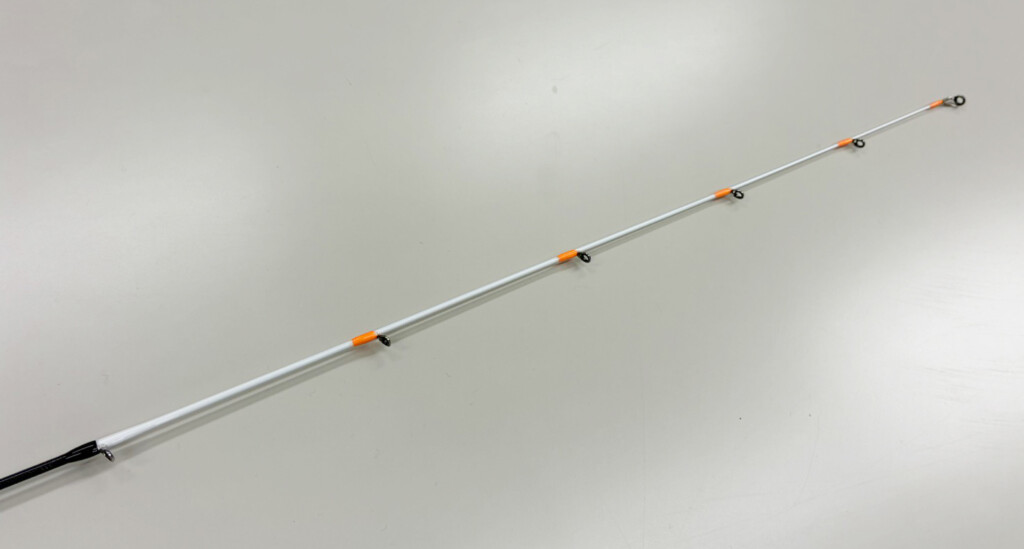
If you’ve been selecting rods purely by length, power rating, and lure weight range — mate, you’ve only been reading half the spec sheet. The tip section is arguably the single most critical variable in how a rod actually feels, detects, and performs in your hands. And no one in Japan is talking about this more intelligently right now than Olympic (Graphiteleader).
The Olympic staff just dropped a masterclass, and we’re breaking it down for every serious JDM tackle enthusiast around the world. Buckle up — this one’s going deep. 🤿
- Olympic’s 6 Tip Classifications — The Full Lineup
- S — Solid Tip: The Ultimate Sensitivity for Ultra-Light Rigs 🌊
- HS — Hard Solid Tip: The Workhorse for Active Strike Fishing ⚡
- HS+ — Hard Solid Tip Plus: Toray T1100G. Yes, THAT Carbon. 🔥🔥🔥
- TS — Titanium Solid Tip: The Jack-of-All-Trades Master 🤖
- GS — Glass Solid Tip: The Squid Whisperer 🦑
- The Solid Tip Selection Matrix — Your Cheat Sheet 📊
- The Big Takeaway: Tip Choice IS Rod Choice 🎯
- Where to Buy JDM Gear
Olympic’s 6 Tip Classifications — The Full Lineup
Before we dive in, here’s the full tip taxonomy Olympic currently uses across their lure rod lineup:
- S (Solid Tip)
- HS (Hard Solid Tip)
- HS+ (Hard Solid Tip Plus)
- TS (Titanium Solid Tip)
- GS (Glass Solid Tip)
- T (Tubular Tip)
Today, we’re laser-focusing on the 5 solid tip variants — and trust me, understanding the differences between these is going to completely rewire your brain when you walk into a tackle shop (or, more realistically, open eBay at 2am looking for JDM gear 😂).
S — Solid Tip: The Ultimate Sensitivity for Ultra-Light Rigs 🌊
The S (Solid Tip) is Olympic’s softest carbon solid tip, built using low-modulus 24t carbon fiber. The result? A smooth, natural, unforced bend that loads beautifully even under the lightest of rigs.
This tip shines brightest in:
- Ajing (light game fishing for horse mackerel)
- Metal Sutte (vertical squid jigging)
- Omori-gu (weighted-rig squid fishing)
- Tip Eging (light squid fishing with tip sensitivity)
What makes the S-tip truly special is its visual sensitivity — what the Japanese call “me-kando” (目感度), or eye-sensitivity. Basically, the tip physically bends and telegraphs bites visually, making it perfect for detecting the ghost-like touches of squid or finicky fish on sub-1g rigs. You see the bite before you feel it.
Featured in: Finezza series, Calamarecci Metal Sutte / Omori-gu models, Paguro series.
👉 Global Angler Tip: If you’re fishing for squid or light-biting species in cooler water (around 15–20°C / 59–68°F) — which in Australia means late autumn through winter (May–August) — this tip style will help you detect those tentative, cold-water touches that tubular tips completely miss.
HS — Hard Solid Tip: The Workhorse for Active Strike Fishing ⚡
Step up in stiffness and you hit the HS (Hard Solid Tip), built with 30t carbon fiber. This gives it noticeably more backbone and rebound energy compared to the S-tip.
The HS is your go-to when you want hand sensitivity (te-kando / 手感度) — feeling the bite transmit through the blank into your palm — rather than watching the tip. It’s the tip type found on the majority of mainstream ajing rods in Japan, and for good reason: it hits the sweet spot between sensitivity and control.
Key strengths:
- Higher repulsion force = sharper hook-sets
- Holds its form in faster current zones without washing out
- Excellent with rigs 2g and above
- Pairs best with “pattsu-n” (パッツン) style blanks — the stiff, high-response rods that serious ajing anglers love
Featured in: 23 Corto, Corto UX, and a wide range of Olympic ajing rods.
HS+ — Hard Solid Tip Plus: Toray T1100G. Yes, THAT Carbon. 🔥🔥🔥
Now we’re talking next-level JDM engineering. The HS+ (Hard Solid Tip Plus) uses Toray’s Torayca® T1100G carbon fiber — one of the most advanced structural carbon materials on the planet.
Compared to the standard HS, Olympic has:
- Reduced resin content
- Increased carbon fiber density
- Achieved simultaneous weight reduction AND higher rigidity
The result is a solid tip that delivers high sensitivity AND high strength at a truly elite level. Olympic themselves note that very few rod manufacturers in Japan are currently using T1100G carbon in solid tips — making this a genuine point of differentiation.
What’s wild about the HS+ is its versatility. On an eging rod, it behaves like a tubular — sharp, snappy, and responsive on the jerk — but then on the drift, it surrenders to current pressure naturally, letting you feel the egi’s presence and weight through the water column. It’s the best of both worlds: tubular sharpness + solid compliance, merged at the highest level.
Featured in: Nuovo Calamarecci, Super Corto, and expanding across multiple light game rod series.
👉 This is the tip for eging anglers who refuse to compromise. If you’re fishing autumn squid in Japan (water temps dropping from 22°C down to 16°C / 72°F to 61°F as squid become more active and aggressive), or Southern Hemisphere spring eging in Australia (September–November, similar temp range), the HS+ gives you the sharpness to work the egi hard AND the sensitivity to detect subtle weight changes on the sink.
TS — Titanium Solid Tip: The Jack-of-All-Trades Master 🤖
This one is genuinely fascinating from an engineering standpoint. The TS (Titanium Solid Tip) uses a super-elastic nickel-titanium alloy — not carbon at all — bringing a completely different set of material properties to the tip section.
Here’s the fundamental challenge in tip design that the TS addresses:
- Increase load sensitivity → you lose vibration/impact sensitivity
- Increase vibration/impact sensitivity → you lose load sensitivity
It’s a classic engineering trade-off. The TS doesn’t fully conquer it (HS+ still wins on impact sensitivity; GS still wins on load sensitivity), but it balances both sides at a genuinely high level — something neither pure carbon type can claim.
The titanium alloy’s natural elasticity gives it a soft, compliant feel when loading up, while still transmitting enough mechanical feedback to keep your hand in the game.
Olympic’s answer to: “I want a soft tip, but I still want decent hand sensitivity.”
Featured in: Corto series, Metal Sutte rods, Tip Run (tip eging) rods.
GS — Glass Solid Tip: The Squid Whisperer 🦑
Last but absolutely not least — the GS (Glass Solid Tip). And for the squid fishing nerds in the audience, this one’s for you.
Glass fiber has a fundamentally different flex characteristic from carbon: it amplifies micro load changes dramatically. The GS tip physically moves — bends, loads, and springs back — in response to the tiniest weight variations. We’re talking about detecting the moment a squid merely touches the sutte, before it fully commits.
In Ika-Metal (Squid Metal Jigging) and other tip-bite-detection styles, this kind of visual sensitivity is game-changing. That barely-perceptible moment when the tip just slightly fails to return to neutral — that’s your bite. And the GS makes that moment visible.
Featured in: Calamarecci Prototype Metal Sutte model.
👉 Global Angler Tip: Squid fishing (whether eging or ika-metal) in colder water (below 17°C / 63°F) means slower, more subtle takes. This is prime GS territory — those gentle cold-water bites that would be invisible on a tubular rod become readable on the GS.
The Solid Tip Selection Matrix — Your Cheat Sheet 📊
| Tip Type | Material | Key Strength | Best For |
|---|---|---|---|
| S | 24t Carbon | Visual sensitivity (me-kando) | Sub-1g rigs, tip eging, omori-gu |
| HS | 30t Carbon | Hand sensitivity, active hook-set | Ajing 2g+, fast current |
| HS+ | Toray T1100G Carbon | Elite sensitivity + strength | Eging, all-round light game |
| TS | Ni-Ti Alloy | Balanced load + vibration sensitivity | Soft feel with te-kando |
| GS | Glass Fiber | Maximum visual load detection | Ika-metal, sutte squid jigging |
The Big Takeaway: Tip Choice IS Rod Choice 🎯
What Olympic has articulated here is something that JDM rod geeks have known for years but rarely see explained so clearly: choosing a tip type IS choosing a fishing philosophy.
Are you a visual bite detector or a hand-feel hunter? Do you want to feel the egi sinking or feel the squid grab? Do you fish light current or ripping tidal flow?
Every answer to those questions points to a different tip — and Olympic has engineered a specific solution for each scenario. That’s not marketing. That’s Japanese tackle precision at its finest. 🇯🇵
Where to Buy JDM Gear
The Olympic / Graphiteleader rod lineup is notoriously difficult to source outside Japan — many of these models are pure JDM spec and simply don’t appear in Western tackle shops. Your best bet for finding authentic Olympic rods, including rare and limited models, is eBay, where Japanese sellers regularly list mint-condition and brand-new JDM gear shipped directly from Japan.
コメント