
- The Problem With Traditional Blade Jigs — And Why Slow Mark Changes Everything
- What Is ON THE BLUE and Why Should You Care?
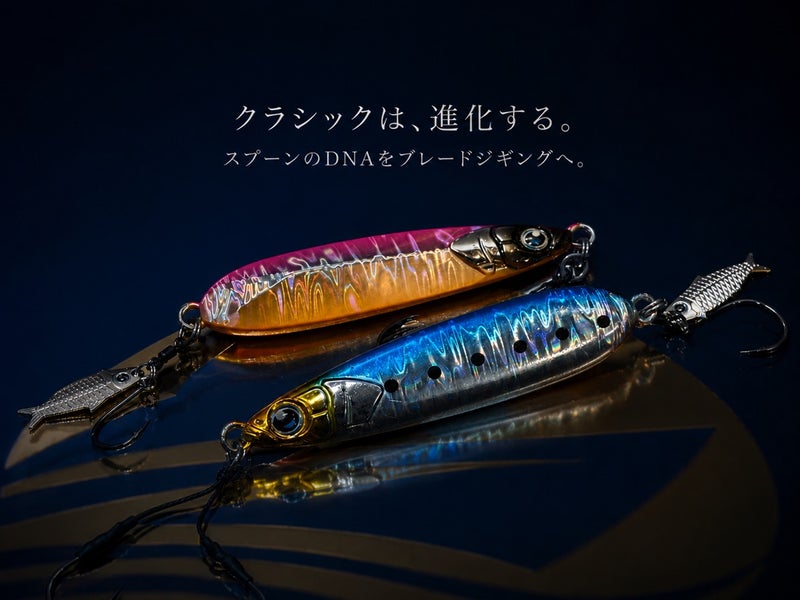
- The Core Concept: Spoon DNA Meets Modern Blade Jig 🧬
- Three Reasons Why the Slow Mark Actually Works
- ① Fish Can’t Read It — Zero Refusals on Slow Retrieve
- ② Exceptional Lift — Works the Full Water Column at Slow Speed
- ③ Maximum Exposure Time — Let Fish Find the Lure
- Fast Fall, Ready to Go Again ⬇️
- Technique: It’s Embarrassingly Simple 🎯
- 6 Color Options — A Palette for Every Condition 🎨
- Specs & Pricing 💰
- Bonus: ON THE BLUE Timeless Life Rod 🎣
- Where to Buy JDM Gear
The Problem With Traditional Blade Jigs — And Why Slow Mark Changes Everything
Let’s be real for a second. Anyone who’s done a full day of blade jigging knows the struggle. High-speed cranking, cast after cast, hour after hour. Your forearms are on fire, your shoulder is done, and you’re half-dead by noon. The conventional blade jig design basically demands that fast retrieve to generate action across the water column — bottom to mid to upper layers. That’s just the physics of the game.
But here’s the thing: not every situation calls for burning it back at warp speed. Pressured fish, post-frontal conditions, finicky snapper — these scenarios scream for a slower, more methodical presentation. And until now, the blade jig category just… didn’t have a real answer for that.
Enter the ON THE BLUE Slow Mark — and honestly, this thing has flipped the blade jig world upside down in Japan. 🇯🇵
What Is ON THE BLUE and Why Should You Care?
ON THE BLUE is the lure brand born out of the charter boat operation Hitomimaru — a professional fishing charter that spends more days on the water than most of us spend thinking about fishing. This isn’t a tackle company designed in a boardroom. Every single lure is developed and tested at sea, on actual fishing charters, with real paying anglers. That real-world feedback loop is genuinely rare, and it shows in the product.
The Slow Mark was born from direct angler feedback that the ON THE BLUE crew heard repeatedly on their charter: “The high-speed cranking is killing me. There has to be another way.” Combined with the team’s desire to create a compact lead lure that could serve as a practical alternative to increasingly expensive and hard-to-source tungsten jigs, the Slow Mark concept was locked in. 💡
The Core Concept: Spoon DNA Meets Modern Blade Jig 🧬
Here’s where it gets really geeky and I am absolutely here for it.
The Slow Mark fuses the design principles of two completely different lure archetypes:
- The Metal Jig — modern, aerodynamic, rear-weighted for casting distance and fast sink rates
- The Spoon — one of the oldest lure forms in existence, dating back to the 1800s, built to generate irresistible action at ultra-slow speeds
Why spoon DNA? Because spoons are the masters of slow-retrieve fishing. Think area trout fishing, native trout streams — spoons work on hyper-pressured, ultra-wary fish that have seen everything. The secret is that irregular, wobbling, fluttering action that pulses with life even at near-dead-stop retrieve speeds. Fish simply cannot ignore it.
The Slow Mark translates that exact principle into a saltwater blade jig format. The result? A fully asymmetric body design that wobbles and flashes on a slow retrieve without rotating — maintaining a stable attitude while generating that seductive spoon-like shimmy alongside the blade’s own independent flash. It’s genuinely innovative JDM engineering at its finest. 🔬
Three Reasons Why the Slow Mark Actually Works
① Fish Can’t Read It — Zero Refusals on Slow Retrieve
The classic criticism of slow-retrieve jigging is that educated fish will follow, inspect, and then simply reject a lure they can see too clearly for too long. The Slow Mark’s irregular spoon-derived wobble breaks that pattern completely. The asymmetric body design prevents rotation while generating an unpredictable, twitchy shimmy that fish cannot categorize as “fake.” Combined with the blade’s separate, distinct flash signature, the total visual package is complex enough to trigger commitment bites even from the most suspicious fish. This is literally spoon science applied to offshore jigging. 🧠
② Exceptional Lift — Works the Full Water Column at Slow Speed
Here’s the physics that makes the Slow Mark special. Conventional blade jigs at slow retrieve speeds sink toward the bottom — they’re simply not generating enough lift to stay mid-water column. This limits slow-retrieve blade fishing to essentially a bottom-bouncing technique.
The Slow Mark’s spoon-influenced body shape generates genuine hydrodynamic lift even at slow retrieve speeds, allowing you to trace the full water column — bottom, mid-water, and even upper layers — all on that same relaxed, taira-ba-paced crank. Think about what that means: you can cover every depth where fish are holding without changing your retrieve speed. That’s a massive tactical advantage, especially when fish are suspended and you’re not sure of the exact depth.
For anglers in Australia and the Southern Hemisphere — this slow-retrieve, full-column approach is absolutely deadly when water temperatures drop into the cooler range (around 15–18°C / 59–64°F) and pelagic species like trevally, snapper, and kingfish become more lethargic and reluctant to chase fast-moving lures. Match their mood. Slow down. Let the Slow Mark do the work.
③ Maximum Exposure Time — Let Fish Find the Lure
The longer a lure stays in the strike zone, the better your odds. Simple math. The Slow Mark’s slow retrieve dramatically extends lure exposure time in the productive water column, giving fish that are hanging on the edge of committing that extra second they need to decide. In SLJ, blade jigging, and madai jigging contexts — where you’re often targeting structure-oriented fish that need coaxing — this extended presentation window is a game changer. Dead-slow bottom approaches with the Slow Mark sound absolutely filthy in the best possible way. 🔥
Fast Fall, Ready to Go Again ⬇️
Despite all the slow-retrieve magic, the Slow Mark doesn’t sacrifice efficiency on the drop. Rear-weighted construction delivers fast sink rates and excellent casting distance — you cast it out, it bombs to the bottom efficiently, and you’re fishing immediately. The compact lead silhouette — engineered to be as dense as possible in a small profile — was specifically designed as a practical alternative to tungsten jigs, which have become genuinely difficult to source and expensive in Japan right now. Lead, done right, with a compact enough form factor to sink like it means business.
Technique: It’s Embarrassingly Simple 🎯
Cast. Hit bottom. One rotation per second. That’s literally it.
That taira-ba pace — the same slow, consistent crank you’d use when slow-rolling a tai rubber — is your baseline. The lure handles everything else. No complex jigging cadence, no arm-destroying speed cranking. Just a steady, lazy retrieve and the Slow Mark works its spoon-jig hybrid magic through the water column.
Target species compatibility is wild — Spanish mackerel (sawara), red sea bream (madai), isaki, rockfish, flatfish (hirame / flounder)… the list goes on. Works from charter boats on SLJ and blade jigging setups, and also fully functional from shore — surf casting and pier fishing included.
6 Color Options — A Palette for Every Condition 🎨
#01 Silver Glow — The ultimate reaction-bite color. Aggressive flash for pelagics and Spanish mackerel. Never leave the dock without it.
#02 Pink Orange Chart — Maximum visual appeal with that fluorescent chart pop. Rare colorway for blade jigs — reach for this when fish seem indifferent to conventional colors.
#03 Purple Gold Glow — Built for depth. Purple plus glow dominates in deep water and over sandy/muddy bottom where contrast is everything.
#04 Red Gold (Akakin) — Arguably the most universally productive color in all of Japanese saltwater lure fishing. Akakin catches everything, everywhere, always. Rockfish and reef species especially.
#05 Green Gold — The undisputed #1 SLJ color in Japan. Overcast skies, murky water, green-gold is your go-to. Dependable as sunrise.
#06 Flashing Iwashi — Match-the-bait sardine pattern. When baitfish are thick and fish are locked on to them, this is your card to play.
Specs & Pricing 💰
| Weight | Price (JPY) |
|---|---|
| 40g | ¥1,430 |
| 60g | ¥1,562 |
| 80g | ¥1,683 |
| 100g | ¥1,804 |
At these price points, this is genuinely accessible JDM innovation. The first production run sold out immediately upon arrival at Japanese tackle shops — and the restock is confirmed for August 2026, with stock being distributed to tackle retailers nationwide. If you’re interested, move fast because this will move fast. ⚡
Bonus: ON THE BLUE Timeless Life Rod 🎣
ON THE BLUE also produces their own purpose-built multi-species rod — the Timeless Life — designed to pair perfectly with the Slow Mark and their broader lure lineup. Available in a 7ft 5in spinning model and 7ft 2in baitcasting model, both featuring a mild tip-to-belly taper for light lure casting and a powerful, tenacious butt section that refuses to give up ground when a fish runs. Both models break down into 5 pieces for travel portability. Serious hardware for serious anglers.
Where to Buy JDM Gear
The Slow Mark is a Japanese domestic market product distributed through Japanese tackle retailers — which means eBay is your most reliable gateway for getting authentic ON THE BLUE gear shipped directly from Japan to your doorstep. Japanese sellers on eBay consistently offer genuine JDM tackle in excellent condition, and it’s the smartest way to access this kind of niche, high-quality Japanese innovation without being on the ground in Japan yourself. 🛒
コメント