
- Stop Guessing Your Egi Color — There’s Actually a Science to This
- It’s Not the Color — It’s the “Change” the Color Creates
- Color #1 — Marble / Neo Sakura-dai 🌸 (Daytime Run-and-Gun)
- Color #2 — Blue Yakko / Blue Aji 🔵 (The Smart Daytime Finesse Option)
- Color #3 — Red / Stripe Army Green Sugi 🌙 (Night Fishing for Size-Up)
- The Big Picture — Think System, Not Single Color
- Where to Buy JDM Gear
Stop Guessing Your Egi Color — There’s Actually a Science to This
Alright, JDM Eging nerds — this one’s for you. 🙌
If you’ve ever stood in front of a tackle shop wall staring at 40 different egi colors and completely blanked out… you are not alone. Color selection is arguably the most debated topic in the entire Eging world, and honestly, most anglers are thinking about it the wrong way.
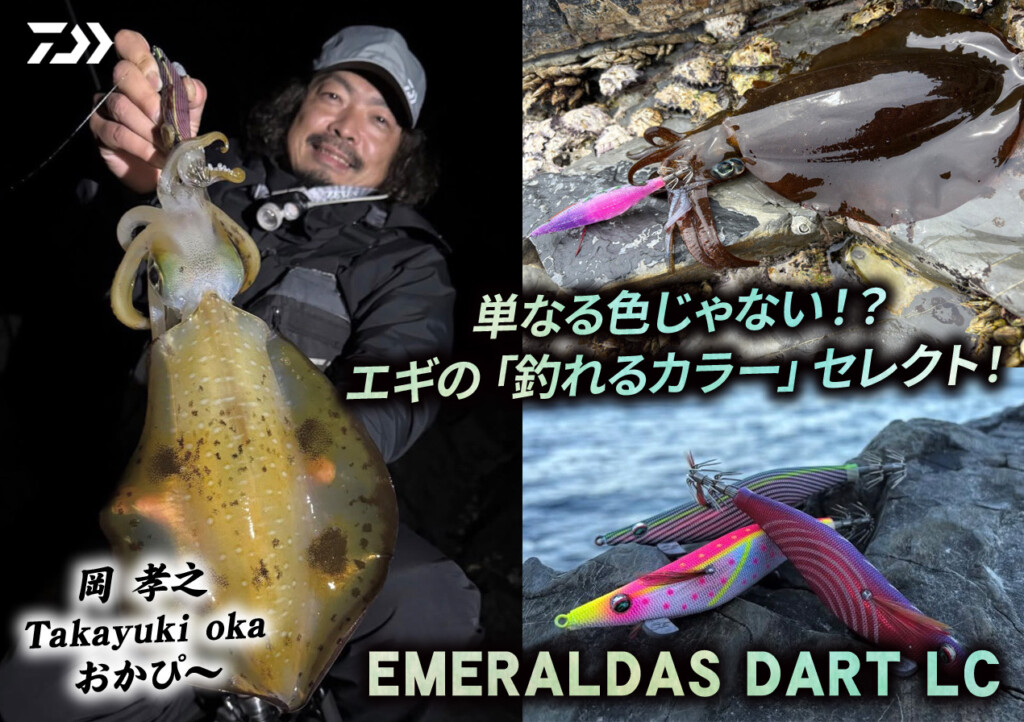
Enter Takayuki Oka — aka “Okapi” — one of Japan’s most respected Eging specialists. This guy has personally prototype-tested dozens upon dozens of egi color variations over his career, logging real squid-response data across different conditions. In other words, when Okapi talks color theory, you shut up and you listen. 🎤
His latest breakdown focuses on the Emeraldas Dart LC — the egi that’s been absolutely setting Japan’s Eging scene on fire this season. Last time, Okapi explained why this egi catches fish beyond just castability and balance. Now? He’s going deep on color logic — and it’s way more nuanced than “use pink in the day, use red at night.”
Let’s break it down. 👇
It’s Not the Color — It’s the “Change” the Color Creates
Here’s the fundamental mindset shift Okapi wants you to make:
The specific color (orange, pink, blue, etc.) is NOT what triggers Aori squid. What actually fires up their predatory instinct is the visual “change” created by the overall combination — the pattern, the gradation, the contrast between the base layer and the outer cloth, and how all of those elements interact with light and water.
Think about it this way: a squid sees your egi approaching. It’s not thinking “oh, that’s pink.” It’s reacting to silhouette size, apparent movement, lifelike texture, and light behavior — all of which are determined by the total color design, not just the surface hue.
Okapi puts it brilliantly: the right color pattern destroys the squid’s rational instincts and triggers pure predatory response. That’s the goal. That’s what we’re engineering here.
Now, with that philosophy locked in — here are Okapi’s three must-have colors for the Emeraldas Dart LC this season. 🔥
Color #1 — Marble / Neo Sakura-dai 🌸 (Daytime Run-and-Gun)
Best scenario: Autumn daytime Eging, shallow structure, run-and-gun style
In Japan, Autumn Eging (roughly September through November) is peak season — water temperatures drop from summer highs into the 18–22°C sweet spot, which triggers Aori squid to move into shallower water and feed aggressively. For anglers in the Southern Hemisphere (e.g., Australia, New Zealand), this translates directly to your March through May period — watch for the same water temp window and expect squid to push into shallower reef edges and structure.
During the day, Okapi’s go-to style is run-and-gun — moving fast, hitting structure after structure in shallow water. For maximum search efficiency, you need an egi that pulls squid in from a wide range.
Enter the Marble / Neo Sakura-dai colorway in the Type S lineup.
Now here’s the genius part — Okapi’s insight is that “visible” does not mean “flashy.” What actually draws distant squid in is perceived size. The fluorescent pink tones used in this color are expansion colors — they create a slightly blurred, bloated silhouette effect. The result? Your 3.5-size egi looks bigger than it actually is to a squid sitting 5 meters away. It gets noticed. It gets investigated. It gets eaten. ✅
Key takeaway: Marble / Neo Sakura-dai = maximum search range via perceived size inflation. Run fast, cover water, let this color do the attracting.
Color #2 — Blue Yakko / Blue Aji 🔵 (The Smart Daytime Finesse Option)
Best scenario: Daytime, mixed light and shadow conditions, around reef and submerged structure
Okay, this is where it gets properly geeky — and Okapi even admits this is the “maniac-level” explanation. Buckle up. 🤓
The Blue Yakko / Blue Aji colorway has no reflective tape and no mirror finish. This means it transmits light rather than reflecting it — which causes the silhouette to diffuse and blur. On paper, this sounds like a weak, low-appeal color. But Okapi’s actual on-water logic flips this completely.
This color is specifically designed for mixed light environments — think submerged rocks, reef ledges, and kelp edges that create alternating patches of bright sunlight and deep shadow. Here’s what happens:
- When the egi enters shadow — the glow element activates, creating a subtle but powerful luminescence that pops in the darkness
- When the egi moves back into bright light — the light-transmitting base diffuses the silhouette, making it look natural and non-threatening
The fluorescent yellow back meanwhile maintains constant visibility as a reference point.
The net result? Appealing without over-appealing. It’s the perfect middle-ground color for pressured fish or situations where you want to show squid something different after hammering them with the Marble / Neo Sakura-dai.
For Southern Hemisphere anglers: This color absolutely shines around rocky reef edges and kelp lines during bright mid-morning sessions — exactly the structure Australasian squid love to hang around.
Key takeaway: Blue Yakko / Blue Aji = intelligent, condition-specific appeal that plays the light/shadow game perfectly.
Color #3 — Red / Stripe Army Green Sugi 🌙 (Night Fishing for Size-Up)
Best scenario: Night Eging, targeting larger Aori squid
Want the big ones? You fish at night. This is not opinion — Okapi calls it an undeniable fact. Aori squid are fundamentally nocturnal hunters, and the largest specimens are overwhelmingly caught after dark, regardless of season.
In Autumn Japan, water temps in the 16–20°C range during the night push larger squid up from depth to feed actively near structure. In Australia/NZ, this mirrors your Autumn/early Winter nights (April–June) when bigger squid move inshore under cover of darkness.
Now — Okapi makes a critical point about night Eging color logic that most anglers miss: Aori squid can ALWAYS see your egi at night. Moonlit or pitch black, their eyes are extraordinary. The challenge isn’t visibility — it’s deception.
At night, you don’t need to attract. You need to convince. And what convinces a squid that something is alive? Movement. Specifically — the illusion of movement even when the egi is falling.
This is the genius of the Red / Stripe Army Green Sugi colorway. The red base creates a crystal-clear, high-contrast silhouette in low-light conditions — squid lock onto it instantly. But the real weapon is the striped pattern that wraps around the curved body of the egi.
As the egi moves through the water — falling, drifting, twitching — the stripes appear to writhe and undulate when viewed from any angle. The squid perceives living movement in what is actually just a piece of resin and cloth. That’s the “life energy” Okapi talks about. It breaks the squid’s logic and triggers the strike. 🦑💥
Key takeaway: Red / Stripe Army Green Sugi = night weapon that uses stripe-induced motion illusion to manufacture lifelike energy. This is the size-up color.
The Big Picture — Think System, Not Single Color
Okapi’s final message is worth burning into your brain:
Never evaluate an egi color in isolation. The outer cloth color, the base layer, the pattern design, the gradation, the reflective or transmissive properties — all of it works as a system to create a total visual package that either triggers or fails to trigger a squid’s instinct.
The three colors above weren’t designed by Okapi himself, and he makes that clear. But as a professional angler who has tested more color combinations than most of us will ever see, he can explain exactly why each one works — and that analytical confidence is exactly why you should trust the recommendation.
His parting advice? Go get these colors before they vanish off the shelves. And when you’re fishing them — think about why the squid is reacting. Build your own understanding. That’s how you level up from angler to Eging artist. 🎨🦑
Where to Buy JDM Gear
Can’t find the Emeraldas Dart LC at your local tackle shop? No surprises there — JDM gear at this level moves fast and rarely makes it overseas through regular retail channels. Your best bet for scoring authentic, Japan-direct stock is eBay, where Japanese sellers regularly list mint-condition and hard-to-find JDM tackles straight from the source. Don’t sleep on it — these colorways won’t hang around. 🚀
コメント