
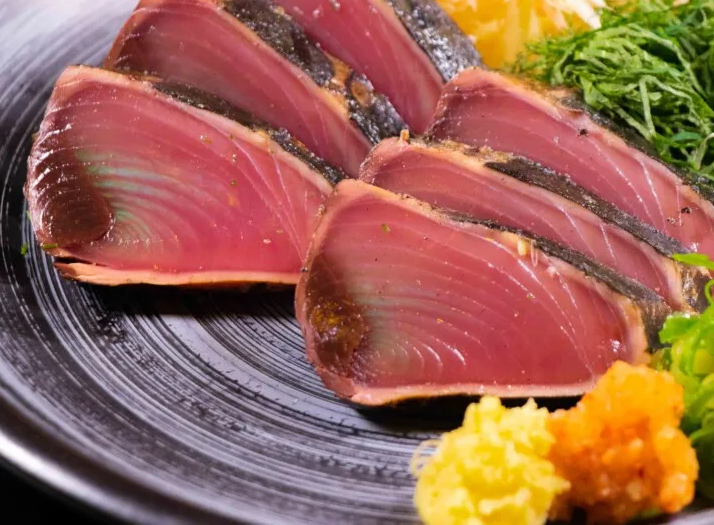
The Question Every Angler-Cook Has Asked
You’ve just landed a fat Bluefin or a hard-fighting Katsuo (Skipjack Tuna) after a killer session. You get home, break out the knife, and slice into that beautiful fillet — and suddenly, the cut surface shimmers with a rainbow glow. 🌊✨
You’ve seen it before. That prismatic, almost holographic shimmer across a perfect slice of sashimi. And here’s the thing — that fish always tastes incredible. Coincidence? Absolutely not.
What Is the Iridescence Phenomenon?
That stunning rainbow shimmer has a name: the Iridescence Phenomenon (イリデッセンス現象 in Japanese). And it’s pure physics, not magic.
It works exactly like the rainbow you see on a CD disc or a soap bubble — light waves interfere with each other as they bounce off microscopic layers within the fish flesh. Specifically, the phenomenon occurs between the protein layers, lipid films, and muscle fiber gaps on the cut surface of the fish, creating that jaw-dropping spectral shimmer.
It’s a simple optical interference effect — but what it tells you about the fish is anything but simple.
Why Rainbow Sashimi = Delicious Sashimi 🐟🌈
Here’s where it gets really interesting for us anglers. The iridescence effect is most likely to appear under these specific conditions:
- The blade is drawn perpendicular (90°) to the muscle fibers — the correct, precise cutting direction
- An ultra-sharp knife is used, cleanly slicing through cells without crushing or tearing them
- The fish has strong, well-defined muscle fibers — think Katsuo (Skipjack), Maguro (Bluefin Tuna), Buri (Yellowtail), and other pelagic powerhouses
Bonus factors that enhance the effect:
- Appropriate fat content — a thin lipid film coating the cut surface amplifies light interference beautifully
- Proper moisture retention — the flesh hasn’t dried out, meaning it was handled and stored correctly post-catch
The Logical Conclusion 🎯
Put it all together, and the message is crystal clear:
Fresh, prime-condition pelagic fish + razor-sharp knife + correct filleting technique = iridescent sashimi that tastes absolutely incredible.
Of course it does. Every single variable that produces the rainbow shimmer is also a direct indicator of peak freshness, ideal fat content, and masterful knife work. When all three align, you’re eating sashimi at its absolute finest. That’s not luck — that’s craft. 🔪✨
What This Means for Anglers Who Eat Their Catch
If you’re catching and eating your own fish — and honestly, that is one of the greatest rewards of being an angler — this is actionable knowledge:
- Invest in a proper Japanese yanagiba (柳刃) sashimi knife and keep it razor-sharp. A dull blade crushes muscle cells and destroys the iridescence before it can form.
- Learn to cut perpendicular to the grain of the muscle fiber. It’s a fundamental technique in Japanese fish preparation, and now you know exactly why it matters scientifically.
- Handle your catch with care from the moment it’s landed — ikejime (神経締め, the Japanese method of instantly spiking the fish’s nervous system) and proper icing preserve moisture and cellular integrity, making iridescence far more likely when you finally slice it up.
A Note for Anglers in the Southern Hemisphere 🇦🇺
In Japan, autumn (September–November, water temps dropping from ~24°C to ~18°C) is prime season for fat-loaded Katsuo and Yellowtail — fish that are naturally high in the lipid content that promotes iridescence. In Australia and New Zealand, your equivalent peak season for similar pelagic species like Yellowfin Tuna, Kingfish (Yellowtail Kingfish), and Bonito tends to fall in late summer to autumn (February–May), when sea surface temperatures are similarly in that 18–24°C sweet spot and the fish are actively feeding and fattening up. Same science, different calendar — the rainbow shimmer doesn’t lie no matter what hemisphere you’re in. 🌏
The Verdict
Next time you’re slicing up your catch, watch the cut surface. Does it shimmer? Does it catch the light and throw back a subtle prismatic glow?
If yes — congratulations. You landed a great fish, you handled it right, and your knife is sharp. That sashimi is going to be extraordinary. 🏆
If not — well, now you know exactly what to work on. The rainbow is the report card, and Japanese anglers have been chasing that shimmer for generations.
Where to Buy JDM Gear
The best sashimi starts on the water — and the best gear to put premium fish on your cutting board comes straight from Japan. eBay is hands-down the #1 source for authentic, high-end JDM fishing tackle shipped directly from Japanese sellers. From rods and reels to specialty eging gear, it’s all there.

コメント